

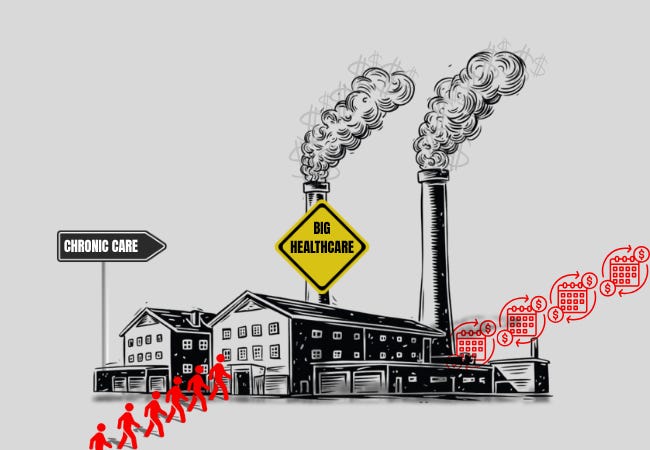
As a patient, the American medical system feels like rolling the dice, blindfolded, unsure of which numbers are even the best numbers, when you walk in and out of a clinic or hospital. What follows is a unique anxiety that comes with opening a medical bill. But if you are chronically ill, that anxiety doesn’t happen once; it happens monthly.
It is unsurprising that most people are on the edge of their seats waiting for medical bills. That’s because the cost of healthcare far exceeds the average American’s income, with no signs of slowing down or meeting a rate of affordability. The United States spends around $4.9 trillion annually on total health care spending, encompassing doctor visits, hospital stays, and prescription drugs.
If you have a chronic illness, your spending makes up a whopping 90% of the U.S. healthcare costs, according to the Centers for Disease Control (CDC). Once diagnosed with a chronic illness, such as type 1 diabetes, heart disease, or cancer, it is as if you have signed up for a lifetime subscription to medical bills that are not so easily dealt with by a stable source of income.
Illness as an Inescapable System
Unlike a one-and-done emergency room visit, patients with chronic illness are required to revisit medical settings over long periods of time, leading to recurring expenses. In 2023, the average annual cost for a patient with a chronic illness was $6,032, five times the cost of those without a chronic illness.
If an individual with a complex disease or diseases needs specialized treatment, the number of obstacles and bills only grows. Types of providers or specialists can be costly, along with the travel time to get there, bills for routine bloodwork pour in, and specialized medications and refills add up over time. The cost of medications alone is dizzying, with U.S. prescription drug spending at $915 billion in 2025. In 2021, Americans spent $1,147 per year on prescription drugs. Throw in a chronic illness diagnosis, and the figure is likely higher. And when you hone in on individuals diagnosed with an autoimmune disease, a subset of chronic diseases, affording treatment is priced as a luxury.
Autoimmune Disease: A Luxury Item
Over 50 million Americans have an autoimmune disease, a chronic, lifelong disease characterized by the immune system attacking the body’s own tissues. Patients with diseases such as rheumatoid arthritis (RA), systemic lupus erythematosus (SLE), and multiple sclerosis (MS) cost the American healthcare system an estimated $100 billion dollars each year. As autoimmune diseases rapidly rise in the U.S., the cost will surely follow.
But reaching an autoimmune diagnosis is not incredibly straightforward or inexpensive. For some patients, it can take months, even years, to come to a definite autoimmune diagnosis. Rounds upon rounds of bloodwork and imaging scans are often necessary, but only at the discretion of a doctor who believes a patient’s experience. Depending on diagnosis, total costs can significantly skyrocket.
These costs contain one of the most important and unavoidable costs of living with an autoimmune disease: treatment costs. Autoimmune disease treatments, such as disease-modifying antirheumatic drugs (DMARDs) and biologics, are significantly more expensive than average drug costs in the U.S., with biologics among the most expensive.
Biologics, such as injections or infusions, are complex drugs made of living cells, requiring advanced technology and manufacturing that significantly spike costs for consumers who need them. Biologics for certain arthritic diseases can cost anywhere between $10,000 and $30,000 per year, a price to be paid for the millions of dollars spent in research, testing, and development of the drug.
And once a patient no longer responds to a drug, they are forced to jump ship to a new, possibly more expensive drug, just to get their symptoms back under control. The cycle of medical bills never stops, while a patient is left to navigate insurance premium nightmares and jump through the hoops of specialty pharmacies to hopefully get their medication delivered on time. If it sounds exhausting to manage, imagine how exhausting it is to keep up with work to afford treating your disease, if you can even keep up at all.
Ghost Costs
Some of the most expensive parts of chronic illness never appear on a medical invoice. Yet, they collect over time through sick days, low energy and productivity, and your emotional bandwidth is stretched thin. Before you even realize it, your paycheck that you desperately need to cover medical expenses begins to reflect these “ghost costs.”
It shouldn’t come as a shock that when you are sick, you are less productive or have called out of work entirely. For those without a chronic illness, an occasional sick day is no big deal. Time and money can be made up; productivity can be recovered. But patients with chronic illness find sick days to be less of a one-in-a-while occurrence, and more of a frequent necessity to take care of themselves. A 2016 study found that full-time employees are regularly absent from their jobs, costing their employers 28.2 million workdays annually, and $4.95 billion in lost income.
Another study found that an individual with a chronic illness can expect their earnings to drop by 12% at the time of their diagnosis, and increase to 18% long-term, due to work limitations. Combine the loss of wages and the rise in medical costs, and you get a nasty, highly prevalent case of medical debt amongst patients with chronic illness.
A poll conducted by the Patient Advocate Foundation’s Center for Patient Research found that one in three adults with a chronic illness has medical debt, as of 2025. The average amount of debt a patient with a chronic illness has, according to the poll, totaled at $3,480, with the majority coming from emergency care and hospital stays. It is an unfortunate and bitter truth that the accumulated debt for many chronic illness patients is nearly inescapable, as long as they have their disease. And for most, they always will.
Reminder! Payment Due Today…and Tomorrow…and the Day After…
The cost of healthcare in America has always been an unsightly can of worms that nobody wants to open or deal with. For patients with chronic illness, although they make up 90% of the medical spending in the U.S., the slow battles to address the costs and debt make way for a domino effect that only perpetuates the cycle further. Like me, patients worry about the cost of their medications, maybe even to the point of skipping them altogether. And suddenly, the cost of groceries seems more important than scheduling a routine doctor’s visit, knowing the bill that will come with it later. For millions of Americans, chronic illness is not just a diagnosis. It is a recurring charge. It trickles down into poor symptom management and poor disease outcomes, landing patients right back at square one of trying to find a solution.
This is the cycle that many with chronic illnesses will be trapped in for the rest of their lives, reducing them to a very important cog in the machine of the American healthcare system that keeps on going.