

There was a day in my chronic illness journey that has stuck with me. It was 7:00 in the morning, and I had just checked in at a treatment clinic for my usual cocktail of drugs via IV infusion. The receptionists were friendly, and I knew their names; the nurses were kind, and I asked how they were. I sat in a leather lounge chair with a heating pad on my left arm, waiting for the “good” vein to pop up for use. The room was brightly lit; they gave me two pillows, per my request, and I sat, making small talk that, on the surface, felt good in light of what would be an exhausting day.
But as the plastic tube and catheter were taped down and the bag of fluid began to drip, even after the nurse asked me how I was feeling and I replied, “good,” deep down, I wasn’t fine at all. This became especially clear when I got into my car after the two-and-a-half-hour treatment and began to cry. It was not a surprising occurrence. Because even after the treatment, the review of my lab results, the lighthearted chatter with my rheumatologist, and the positive “everything looks good!”, I felt a crushing force of all the exhaustion, the dulled pain, all the grief, and the reality of living a life I hadn’t imagined, even just a year ago.
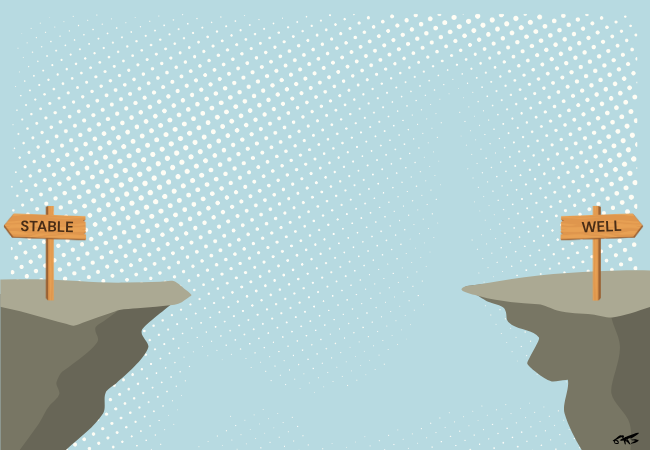
It was a force that was blurring the memories of my old life, dragging me into a painful reality that I’ll be some form of sick for the rest of my life. This is a feeling that conventional clinical measurements do not always adequately capture. This is the agonizing truth that many chronic illness patients experience. When good on paper doesn’t feel good at all, where do you go from there?
Good Numbers, Bad Days
The clinical classification of “improved” or “normal” does not necessarily reflect a patient’s lived experience. Feeling “well” is often a phantom we see in daydreams or recall in distant memories of who we used to be before disease crept in. But control on paper is like a long checklist that, once fulfilled, makes it difficult to measure the patient’s life outside the disease, a life that still feels unwell.
Laboratory values, in combination with examination findings and disease activity scores, stack up to show improvement. There are numbers, and then there are more numbers. Summaries and figures that define where the patient stands clinically. You get good numbers, and you can breathe a little. Your disease hasn’t gotten worse. But that doesn’t negate the chaos and greyness the disease still leaves in its wake.
My disease had been controlled, on paper. But I was frequently at a loss when it came to sleep, and the domino effect on function that followed. I averaged four to five hours of light sleep per night and woke stiff, like I had been hit by a truck, as I liked to describe it. What followed, depending on the day, was energy masked by lots of caffeine that would eventually make me feel worse, irritability and my unfortunate tendency to snap every now and then, and the uncontrollable inability to focus.
Some days it felt like I was moving through freshly poured cement. Other days, it felt like swimming with a heavy sweater on.
Days blurred together, tasks were left unfinished, and the constant existential weight of no longer recognizing myself, no longer seeing the energetic, social, and invincible girl I still mourn, would only seal the cycle to repeat all over again.
My rheumatologist had measured my disease’s activity, its progression, and the efficacy of the drugs I took to slow it down. What he had not measured was what the disease had done to me and my quality of life, a much more subjective measure.
I Cannot Treat What I Cannot See.
Measurement of disease has undergone thousands of years of growing pains to accurately determine what’s plaguing a patient and to increase the likelihood of their survival.
When you look at the scale of how much science has changed, there was a stretch of centuries during which medical science shifted only slightly here and there, even as the world around people was growing increasingly modern.
Throughout history, particularly in ancient times, there were a few standards for diagnosing a patient based on the signs they presented: physical observations, pulse readings, uroscopy (examination of a patient’s urine), and listening to the patient’s narrative.
As different plagues swept across ancient and eventually medieval cities, herbal and botanical remedies were popular, and hygienic therapy- the practice of bathing regularly, among other practices - was a pillar that medicine leaned on for treatment. Bloodletting was especially common in response to determining that a patient had “too much” blood.
These practices continued alongside the work of scientists who invented microscopes, discovered germ theory, and pioneered surgeries over the next centuries.
For a long time, physicians developed theories of disease even when they couldn’t see it or understand its origin. And before empirical measurements came along, doctors and physicians relied on several theories about what was going on inside the diseased human body, the most popular being an imbalance in the four bodily humors, or fluids: blood, yellow bile, black bile, and phlegm. Each humor carried unique traits, and when imbalanced, it contributed to illness.
But the 19th century saw a boom in medical innovations and advancements, particularly in our understanding of disease and illness, paving the way for different standards of diagnosis and treatment. With the evolution of pathology, disease was finally understood to come not from bodily humors, but from cells and their pathological changes. Rudolf Virchow, a German-born scientist, helped establish the field of cellular pathology, urging other scientists to focus on microscopic and anatomical methods.
By the turn of the 20th century, laboratory testing had expanded to combat disease outbreaks and improve diagnostic precision. As research progressed, disease activity could be quantified more consistently, and various disease activity scores, such as scores for rheumatoid arthritis, were eventually standardized.
Disease was becoming increasingly easier to measure. As objective measurements became more successful and authoritative, personal experience received less clinical weight.
“Sickly” is the Word
I have frequently used the word “sickly” to describe myself and others, although it is used to describe a much more dramatic image. When someone of average health hears me use the word “sickly,” I can see their face change in a way that tells me they’re imagining I’m supposed to look frail, congested, clammy, and pale 24/7. Like I’m dying from some mysterious illness of which no one has found a cure.
Instead of a much more dramatic appearance than people tend to imagine, the word “sickly” describes someone as being often weak or feeling sick. When you put it like that, the definition sticks to chronic illness patients, but its measurement is not something doctors always address.
A patient can be improving on their medication, show few signs of disease activity, but still experience “sickly” symptoms, not always derived from the disease but from its effects that ebb and flow. For some, it could be structural damage from before the disease got wrangled under control; irreversible damage that eventually just becomes part of everyday life even though things look and feel different. For others it could be heightened sensitivity to pain, anemia or other nutritional deficiencies, or, in my case, sleep disorders.
Alongside these symptoms and changes are the gifts of being sickly that do not physically manifest like the others: depression, anxiety, and even medical or disease-related trauma — states of mind that are sometimes so naturalized that you begin to forget how you felt mentally before the disease came along.
A common denominator among many patients with chronic illness, one that eludes the science of measurement, is fatigue. Fatigue is the shapeshifting monster that never really comes from just one place, but from multiple. Not just a lack of sleep, but possibly a spike in unexplained inflammation, the pain that may follow, or even a side effect of a medication. Its intangible complexity is so frustrating, and even though it’s everybody’s concern in theory, it’s nobody’s responsibility in practice.
By the time you’re due for your next assessment, the difference in priorities may appear black and white. Medical care is often structured to focus on the numbers and data that string together results and progression, and on medication efficacy to tie things up in a bow.
Meanwhile, you’ve been so tired that the appointment was hard to go to in the first place. You can’t remember the last time you enjoyed a hobby or easily got through a full day of work. The numbers and data point to your disease being controlled. But they don’t point to getting your life back.
What is Actually Living?
In the grand checklist of disease management, quality of life may become the last box. It often receives explicit attention to prevent organ damage, restore bodily functions, minimize risk, and return the patient to baseline. Quality of life improves, but something is still missing: a restored life.
The priorities of treating a disease can eclipse the priority of giving a patient their life back. Why can’t biological control and lived experience be balanced in the management of a disease? Because, after all, isn’t managing this disease managing the human who bears it? Including every aspect of how they think, feel, behave, and will see themselves for the rest of their lives.
But there still seems to be a gap between those who need support and the system with the means to provide it. Receiving support is not the same as having it offered without follow-through—a distinction often lost in completed doctor-patient questionnaires and 15-minute appointments.
The support only matters if offering it actually leads to tangible resources, change, and ongoing investigation.
Handing a patient a disease and quality-of-life survey and then filing it away sans investigation reinforces clinical measurement without humanized change.
Two Birds, One Patient
Science and the study of how cells and medications interact are astonishing in their own right, but so is the patient’s life. The two should be measured distinctly but addressed together if living with chronic illness is ever to be considered more than doable.
A doctor’s language, the typical “things have improved!” often unintentionally envelops feelings and experiences as improved alongside disease activity. Instead, the language should be broken down into more specific terms to highlight exactly what has improved, rather than assuming everything has improved.
“You have less disease activity, and no new damage to your organs or tissues. However, you are still having trouble sleeping and functioning at work. Let’s come up with a treatment plan for that.”
Two different paths, two different experiences, one patient.
As the patient’s lived experiences gain recognition, those experiences should be tracked over time (put those questionnaires to good use!) so clinical encounters can assess them even without changes in the disease.
It is a lot to ask of a system that rewards volume and patient turnover while limiting prolonged patient conversations. That itself is an entirely separate issue worth discussing. But even in 15 minutes, imagine what could be done if we recorded quality of life as much as we record disease activity?
Imagine what could also be done if the system were changed so that quality of life is measured from the first diagnosis? If a patient is treated with equal parts scientific curiosity and humility, and asked: “What has your disease taken away from you?”, I imagine the journey of living with a chronic illness would be easier from the get-go.
Control as the Beginning, Not the End
I am sitting in my living room while I write this; my hands are able to move over my laptop’s keyboard quickly, like some sort of hacker. I can’t remember the last time my hands hurt enough to the point where I couldn’t move them like this. That is one of the little wins that reminds me to be grateful for my bottle of Rinvoq tablets upstairs.
I know the ins and outs of my disease and the medicine that works against it. I know my doctor’s name, first and last, and he doesn’t treat me like an idiot, which I appreciate. He knows the science, the biology, and the standard procedures for individuals like me.
But there is little acknowledgment that the questionnaires still reflect an increasingly blue mental state here and there, the lack of sleep, and the inability to focus at work, sometimes for days. But he still looks at me with his soft grin and a glow of happiness that he did it. He controlled my disease*.* The control I am grateful for. But it is not the same control that governs my life, thoughts, feelings, aspirations, energy, and strength.
They are two separate realities that, like me, leave many patients feeling adrift from wellness. Control is valuable and essential, but it must be treated as the beginning, not the end, of feeling well.
Wow, this is a really powerful post. Yes! Yes! Quality of life! There is indeed so much focued on lab results, irrelevant numbers, disease progression. But no, I can't remember my PC doc EVER asking about my quality of life.🤷
He sees me come in - smiling, trying to be upbeat, probably looking like a regular person with no cares. Well, he usually notes I'm anxious (which I'm not when I come in); I'm just trying to be friendly and informative of my conglomerate of symptoms. Then later, I get to hear I'm such a complex patient...😓
Try living a day in my world with my pain, my limitations, my dysfunction, and then talk to me about being anxious and complex! You wouldn't last an hour, buddy...